

Board Performance · 2025
In this section13 topics
- Prevention of Conflicts of Interest3 items
- Prevention of the Use of Inside Information3 items
- Anti-Corruption4 items
- Whistleblowing3 items
- Selection of Directors & Chief Executives5 items
- Selection of Independent Directors2 items
- Director Development1 item
- Evaluation of Board & Subcommittee Performance2 items
- Subcommittees1 item
- Meeting Attendance & Remuneration3 items
- Supervision of Subsidiaries & Associated Companies4 items
- Audit Committee Duty Performance1 item
- Executive Committee Duty Performance1 item
Prevention of Conflicts of Interest
Has the Company Acted to Prevent Conflicts of Interest?
Yes
Operations in the Past Year
The company has established a conflict of interest policy based on the principle that all decisions made by personnel at all levels in conducting business activities must be solely for the company's best interests. Such decisions must be made free from the influence of personal, family, or close associate interests that could affect the determination of what constitutes the company's best interests. Specifically, all personnel must work full-time for the company to the best of their ability and should not have any other external business interests that would encroach upon their time or dedication to their responsibilities to the company and potentially cause harm to the company.
A conflict of interest arises when personnel at any level have personal, family, or close associate interests, whether financial or otherwise, in an enterprise that would benefit from
1 The decision of that individual in performing duties for the company, or
2 Awareness of the company's operational activities or future plans.
The company considers it the duty of personnel at all levels to avoid financial involvement and/or relationships with other external parties that would result in the company losing benefits, or creating conflicts of loyalty or interest, or hindering efficient operations. The company's policy is to protect its legitimate interests while simultaneously minimizing the restriction of freedom in various activities of personnel at all levels.
Annual review of conflicts of interest.
Annually, personnel at all levels will be informed to review and be aware of the company's conflict of interest policy. Everyone must report any potential conflicts of interest that arise to the Office of the Managing Director, attaching relevant details, so that they can be compiled for discussion with the Managing Director before the Office of the Managing Director communicates the company's stance to the individual and their supervisor, and
Everyone should always report such matters when they may arise during the year.
In cases of concrete conflicts of interest, if personnel disclose and cooperate fully with the company when such conflicts arise, the issue can be resolved by that individual recusing themselves from decision-making in matters that are the source of the conflict.
In cases of doubt or uncertainty regarding the appropriateness of one's own actions, or if one becomes aware of potential non-compliance with the company's conflict of interest policy by other personnel, everyone should consult with their supervisor, the Human Resources Department, the Office of the Managing Director, or the Internal Audit Office, as appropriate.
Number of Conflict-of-Interest Cases
| Metric | Current Year | Previous Year | Two Years Ago |
|---|---|---|---|
| Total number of cases or issues related to conflicts of interest (cases) | 0 | 0 | 0 |
Prevention of the Use of Inside Information
Has the Company Acted to Prevent the Use of Inside Information?
Yes
Operations in the Past Year
The Board of Directors and designated management are responsible for reporting their securities holdings in accordance with the regulations of the Stock Exchange of Thailand and the Securities and Exchange Commission.
The Company must ensure fairness and equality for all shareholders and prevent illegal actions by personnel at all levels of the Company and their families who have received or may receive non-public inside information. Therefore, the Company prohibits all directors, executives, and employees from trading shares or soliciting others to buy, sell, offer to buy, or offer to sell the Company's shares, whether directly or through brokers, while possessing non-public inside information. The Company and the Stock Exchange of Thailand consider such trading to be for speculative purposes or to create an advantage for any particular group.
Prevention measures to ensure smooth policy implementation. The Company has taken the following actions:
Restrict access to non-public information, allowing only relevant and necessary personnel to be aware of it.
Implement a workplace security system to protect confidential files and documents.
It is the duty of the owner of non-public information to strictly instruct relevant personnel to comply with security procedures.
Penalties for the Use of Inside Information
Violators will be subject to disciplinary and/or legal action, as the case may be.
The Company has established a policy prohibiting directors, executives, and employees/staff of the Company who are in positions or departments responsible for or having access to inside information, including their spouses and minor children, from buying or selling the Company's securities during the period of 15 days prior to the disclosure of the Company's financial statements and important financial information, and during the period of 1 day after the disclosure of the Company's financial statements and important financial information. Every three months, the Company will inform directors, executives, and employees/staff of the Company who are in positions or departments responsible for or having access to inside information about the prohibited trading period for the Company's securities.
Report on shareholdings of directors, including spouses and minor children of directors.
Par value of 1 Baht per share | ||||
Order | Name | Ordinary shares (shares) | Number of shares increased (decreased) | |
As of January 1, 2025 | As of December 31, 2025 | During the year (shares) | ||
1. | Mr. Wirat Pairatpiboon | - | - | - |
2. | Mrs. Sunanta Tiasuwan | - | - | - |
3. | Mr. Preeda Tiasuwan (Spouse: Mrs. Sunanta Tiasuwan) | 1,400,000 | 1,400,000 | - |
4. | Mrs. Wanna Thamasirithap | - | - | - |
5. | Mr. Jetsada Promjat | - | - | - |
6. | Miss Supitcha Chaipipat Appointed by resolution on April 28, 2025 | - | - | - |
7. | Mr. Thanin Subboonruang Appointed by resolution on April 28, 2025 | - | - | - |
8. | Mr. Trak Bunnag Appointed by resolution on April 28, 2025 | - | - | - |
9. | Mr. Paiboon Wongchongjaiharn | - | - | - |
10. | Mr. Thitiwut Sukpornchaikul | - | - | - |
11. | Mr. Natthawit Boonyawat | - | - | - |
12. | Mr. Pairoj Wattanawarodom | - | - | - |
13. | Mr. Chatchawin Charoenratchapak Held office until April 28, 2025 | - | - | - |
14. | Mr. Tinawat Mahatharadorn Held office until April 28, 2025 | - | - | - |
15. | Mr. Pongpinit Dechakhup Held office until December 14, 2025 | - | - | - |
Number of Inside-Information Cases
| Metric | Current Year | Previous Year | Two Years Ago |
|---|---|---|---|
| Total number of cases or issues related to the use of inside information to seek benefits (cases) | 0 | 0 | 0 |
Anti-Corruption
Has the Company Acted on Anti-Corruption?
Yes
Operations in the Past Year
The company recognizes the importance of anti-corruption and is committed to conducting business based on legal principles, ethical principles, good corporate governance, and honest practices in accordance with its mission. It adheres to correctness and high ethical standards, as well as being responsible to society, the environment, and all stakeholders. This is to ensure that the company has a policy defining appropriate responsibilities, practices, and operational requirements for preventing corruption in all its business activities, and to ensure that business decisions and operations that may carry corruption risks are carefully considered and executed. Over the past year, the company has reviewed and updated its anti-corruption policy to ensure its suitability and alignment with current circumstances. This policy has been reviewed by the Audit Committee and approved by the Board of Directors. This policy covers subsidiaries, joint ventures, other companies over which the company has control, as well as business representatives, partners, and customers involved in the company's business operations and the company. Confirming the "Zero Tolerance Policy for all forms of corruption" Strictly.
Guidelines
Company personnel must comply with the anti-corruption policy and must not be involved in corruption, whether directly or indirectly.
Company personnel must not neglect or ignore any acts that constitute corruption related to the company. It is their duty to inform their supervisor or the responsible person and cooperate in verifying facts. If there are any doubts or questions, they should consult with their supervisor or the designated person responsible for monitoring compliance with the code of conduct through the specified channels.
The company will provide fairness and protection to company personnel who refuse corruption or those who report corruption related to the company, by implementing measures to protect individuals who comply with the anti-corruption policy, complainants, or those who cooperate in reporting corruption (Whistleblowing Policy).
The company recognizes the importance of disseminating information, providing knowledge, and fostering understanding among its internal personnel, as well as external individuals who perform duties related to the company, regarding compliance with the anti-corruption policy.
The company is committed to building and maintaining an organizational culture that upholds the principle that corruption, whether arising from any transactions and/or business with both public and private sectors, is unacceptable.
The company has a risk management committee to assess potential corruption risks in advance and has effective control and audit processes.
The company has a policy to comply with laws related to anti-corruption in Thailand and in all countries where the company operates.
The company will take reasonable steps to ensure that its agents, contractors, or any individuals conducting business or having legal relations with the company are aware of the company's operating principles under this policy.
Operational Guidelines
To ensure clarity in handling matters with high corruption risk, the company requires its personnel to perform their duties with caution and adhere to the company's guidelines on the following matters:
Giving/Receiving Gifts, Entertainment, and Hospitality must comply with the company's code of conduct.
Charitable Donations and Sponsorships: Must be transparent and lawful, ensuring that donations, sponsorships, or assets are not used as a pretext for bribery.
Facilitation Payments: As the company has a policy of not making facilitation payments in any circumstances, it is prohibited to make facilitation payments to government officials, whether directly or indirectly.
Political Contributions: The company maintains political neutrality and will not engage in any actions that favor or provide financial or other forms of support to political parties, political action groups, political authorities, and political candidates, whether directly or indirectly, at local, regional, and national levels.
Conflict of Interest: The company requires the disclosure of personal interests related to the company's business operations, avoidance of decisions that may involve conflicts of interest, and reporting to the authorities when situations that may lead to conflicts of interest are identified, so that the company can manage them appropriately, transparently, and accountably.
Employment of Government Officials (Revolving Door): The company prohibits the employment of current or former government officials who have left their positions for less than 2 years in roles that could create conflicts of interest. Measures will be put in place to disclose the employment of current or former government officials to ensure transparency and accountability.
Business Relations and Procurement with Public and Private Sectors: The company prohibits giving or receiving bribes in all types of business operations. Interactions with public and private sectors must be transparent, honest, and conducted in compliance with relevant laws.
Form of Anti-Corruption Operations
| Operation |
|---|
| The participation in anti-corruption projects |
| Review of appropriateness in anti-corruption |
| Communication and training for employees on anti-corruption policy and guidelines |
| Review of the completeness and adequacy of the process by the Audit Committee or auditor |
Number of Corruption Cases
| Metric | Current Year | Previous Year | Two Years Ago |
|---|---|---|---|
| Total number of cases or issues related to corruption (cases) | 0 | 0 | 0 |
Whistleblowing
Has the Company Implemented Whistleblowing Procedures?
Yes
Operations in the Past Year
The company prioritizes good corporate governance, transparency, and accountability to stakeholders, and therefore has established “Complaint and Whistleblowing Policy” (Whistleblowing Policy) to serve as a mechanism for preventing, investigating, and elevating business operational standards to comply with laws, regulations, and business ethics principles. The aim is to ensure that the receipt and investigation of reports are systematic, transparent, verifiable, and fair, as well as to build confidence among whistleblowers that the company has appropriate and strict protection measures in place. This is to foster an organizational culture committed to honesty, integrity, and compliance with the regulations of the Stock Exchange of Thailand, as well as the practices of the Collective Action Against Corruption (CAC) project of the Thai private sector. In the past year, the company reviewed its complaint and whistleblowing policy, which was vetted by the Audit Committee and approved by the Board of Directors.
The company provides opportunities for all groups of stakeholders to report complaints or provide information, including directors, executives, employees at all levels of the company and its subsidiaries (including temporary/contract employees), shareholders, business partners, contractors, agents, brokers, customers, consumers, investors, creditors, government agencies, communities around the operational areas, as well as general external individuals who have information or evidence beneficial to the company's investigation. The company accepts complaints or information on issues that may affect the accuracy, transparency, safety, and reputation of the organization, covering the following matters:
Violations of laws, government regulations, capital market rules, or company regulations, including non-compliance with good corporate governance principles, business ethics, or unfair or discriminatory practices in the workplace.
All forms of corruption, such as giving/receiving bribes, embezzlement, fraud, abuse of power, non-transparent procurement, or illicit gain.
Conflicts of ethics or standards of conduct, such as conflicts of interest, abuse of power for personal gain or for associates.
Human rights violations, workplace harassment, sexual harassment, or bullying.
Circumstances that may cause harm to life, body, health, or the environment, including negligence regarding such risks.
Concealment of facts that should be disclosed, or reporting/preparing untrue documents, information, or evidence that may affect the company, shareholders, investors, capital markets, regulatory bodies, or stakeholders.
Any other actions that constitute ethical misconduct or may cause damage to the company's reputation, interests, or credibility.
Channels for Complaints/Whistleblowing
To enable stakeholders to submit complaints/whistleblowing reports conveniently, securely, and confidentially, the company has established reporting channels with restricted access rights and designated two main receiving units: the Audit Committee and the Internal Audit Office. Reports can be submitted through the following specified channels:
Channels for reporting to the Audit Committee
Email of the Audit Committee: auditcommittee@estarpcl.com
Mail: Address the envelope with "Confidential Document" to "Chairman of the Audit Committee" and send it to Eastern Star Real Estate Public Company Limited, No. 898, 5th Floor, Ploenchit Tower, Ploenchit Road, Lumpini Subdistrict, Pathumwan District, Bangkok 10330.
Channels for reporting to the Internal Audit Office
Email of the Internal Audit Office: internalaudit@estarpcl.com
Mail: Address the envelope with "Confidential Document" to "Internal Audit Office" and send it to Eastern Star Real Estate Public Company Limited, No. 898, 5th Floor, Ploenchit Tower, Ploenchit Road, Lumpini Subdistrict, Pathumwan District, Bangkok 10330.
Online System Channel (Web Portal)
Complainants can submit reports via the online system at www.estarpcl.com/complaint The system will restrict data access rights exclusively to the Audit Committee and the Internal Audit Office to maintain data confidentiality and security.
Process for Handling Complaints/Whistleblowing Reports
When the company receives a complaint or information through the designated channels, to ensure that the investigation is accurate, transparent, fair, and strictly protects the rights of the complainant, the company has established the following operational procedures:
Receipt of Complaints
When a complaint or whistleblowing report is submitted through the company's designated channels, whether through the Audit Committee or the Internal Audit Office, it shall be considered an official receipt of the matter. If a matter is sent to another department other than the two designated above, the recipient must immediately forward the matter to the Audit Committee or the Internal Audit Office as appropriate, or within 2 (two) business days from the date of receipt. The company has limited the number of recipients to a minimum to ensure strict and secure control over data access.
2. Preliminary Fact-Finding
The Internal Audit Office and the Human Resources and Administration Department are jointly responsible for conducting preliminary fact-finding. This involves verifying the completeness of information, assessing initial materiality, and recording the matter in the company's complaint registration system. The preliminary investigation shall be completed within 7 (seven) business days from the date the company receives all necessary and sufficient information and supporting documents for the preliminary investigation. After the preliminary fact-finding, an opinion must be submitted to the Audit Committee on whether a formal fact-finding investigation should be conducted. In cases where a complaint involves an individual holding the position of Senior Department Director or higher, or a senior executive, or a company director, the Internal Audit Office must immediately forward the matter to the Audit Committee without considering its content.
Appointment of a Fact-Finding Working Group
When the Audit Committee considers that a fact-finding investigation is warranted, the Audit Committee shall appoint a fact-finding working group consisting of the following personnel:
The Internal Audit Office consists of the Internal Audit Department and the Company's Compliance Department. (Compliance)
Human Resources and Administration Department
The highest-ranking supervisor of the accused
In cases where a complaint involves an individual holding the position of Senior Department Director or higher, or a senior executive, or a company director, the Audit Committee will oversee the entire investigation and may consider appointing an independent investigator or auditor, or determining additional components of the fact-finding working group as appropriate. The results of such investigation will be forwarded to the Nomination and Remuneration Committee for their opinion and deliberation before being reported to the Board of Directors for further consideration and action as deemed appropriate.
1. Consideration and Fact-Finding
The fact-finding working group will collect information, examine documents, interview relevant individuals, and analyze facts based on available evidence. They must adhere strictly to principles of neutrality, prudence, transparency, and confidentiality. A report of the investigation results must be prepared and submitted to the Audit Committee for consideration. The aim is to complete the process within 30 (thirty) days from the date of appointment for the fact-finding investigation, except in complex cases where the fact-finder may request an extension as necessary, providing reasons and an estimated completion time to the complainant.
2. Monitoring and Conclusion
The Internal Audit Office will monitor progress and record the operational status until the process is completed, and report to the Audit Committee for acknowledgment.
3. Notification of Results to Complainants
After the fact-finding process is completed and the company receives the official investigation report, the company will notify the complainant of the consideration results or investigation findings within 7 (seven) business days from the date of receiving such results. The reporting of results will maintain confidentiality and disclose only necessary information to avoid affecting personal rights or related disciplinary and legal processes, unless the complainant or whistleblower has not disclosed their name or contact information, in which case the company will not be able to provide updates on the actions taken.
Guidelines for Protecting Complainants/Whistleblowers
The company has strict guidelines for protecting and safeguarding the rights of complainants, whistleblowers, information providers, and all related parties, and will maintain the confidentiality of all related information and identities. Disclosure will only be made as necessary for investigation or as required by law. The company prohibits any retaliation, harassment, intimidation, threats, termination, demotion, or any actions that may cause direct or indirect harm to complainants or information providers. In cases where a complainant or whistleblower is affected by such actions, the company will consider appropriate remedial and protective measures, including providing an opportunity for complainants to report directly to the Chairman of the Audit Committee or an independent director if they believe they have not received adequate protection.
The company regularly reports the results of corruption-related complaints to the Audit Committee every quarter. In the past year 2025, there were no complaints or whistleblowing reports regarding ethical misconduct, non-compliance with corporate governance principles, or corruption involving the company, its directors, or employees. The company has maintained measures for policy communication, control of reporting channels, and periodic review of channel security, as well as providing advice to employees on corruption risks, to prevent and reduce the likelihood of undesirable incidents and to ensure that if a report is made, the company can act efficiently, transparently, and fairly.
Number of Whistleblowing Cases
| Metric | Current Year | Previous Year | Two Years Ago |
|---|---|---|---|
| Total number of cases or issues received through whistleblowing channels (cases) | 0 | 0 | 0 |
Selection of Directors & Chief Executives
Directors & Chief Executives — Introduction
Recruitment of Directors and Senior Executives
The Board of Directors consists of no more than 12 directors. The Board of Directors has appointed the Nomination and Remuneration Committee to select and screen individuals to be appointed as directors, including senior executives. The Company does not specify the method for electing directors by cumulative voting but uses the majority vote of the total votes of shareholders attending the meeting and entitled to vote. The selection of directors can be done by electing directors individually, one at a time, or several individuals together as a group, or by any other method as deemed appropriate by the shareholders' meeting. However, in each resolution, shareholders must cast votes equal to one share per one vote and cannot divide votes among any person or group. Furthermore, the Nomination and Remuneration Committee
also has the duty to recruit, select, or screen senior executives for the following positions: Chief Executive Officer and/or Managing Director, Deputy Managing Director, and Assistant Managing Director, as well as those holding equivalent positions in organizations or businesses in which the company holds 50% or more of the shares.
Are Directors Selected Through the Nomination Committee?
Yes
Are Chief Executives Selected Through the Nomination Committee?
Yes
Rights of Minority Shareholders on Director Appointment
The Company has issued a news announcement through the Stock Exchange of Thailand's system in accordance with good corporate governance principles to allow minority shareholders to participate in the Annual General Meeting of Shareholders. The Company therefore provides an opportunity for shareholders to propose matters for inclusion as agenda items and/or nominate individuals for consideration and election as directors for the Annual General Meeting of Shareholders 2025 in accordance with the criteria specified by the Company. Shareholders may submit proposals from October 16, 2024 to January 16, 2025
Method of Director Appointment
| Method | Other — Please Specify |
|---|---|
| Other | The election of the company's directors shall be conducted by the shareholders' meeting, whereby each shareholder shall have one vote per share. The voting for the election of directors shall be by a majority vote. In the event of a tie vote, the chairman of the meeting shall cast the deciding vote. |
Selection of Independent Directors
Criteria for Selecting Independent Directors
Selection of Independent Directors
The company has established criteria for the selection and appointment of independent directors based on the qualifications of “independent directors” as stipulated in the Capital Market Supervisory Board Notification No. TorJ. 39/2559, dated November 16, B.E. 2559 (2016), as follows:
a) Holding shares not exceeding 1% of the total voting shares of the applicant, its parent company, subsidiaries, associated companies, major shareholders, or controlling persons of the applicant. This includes shares held by related persons of that independent director.
b) Not being or having been a director involved in management, an employee, staff, a salaried advisor, or a controlling person of the applicant, its parent company, subsidiaries, associated companies, fellow subsidiaries, major shareholders, or controlling persons of the applicant, unless they have been free from such characteristics for at least 2 years prior to the date of submitting the application to the office. However, such prohibited characteristics do not include cases where an independent director was previously a government official or an advisor to a government agency which is a major shareholder or a controlling person of the applicant.
c) Not being a person related by blood or legal registration as a father, mother, spouse, sibling, or child, including the spouse of a child, of other directors, executives, major shareholders, controlling persons, or persons proposed to be directors, executives, or controlling persons of the applicant or its subsidiaries.
d) Not having or having had a business relationship with the applicant, its parent company, subsidiaries, associated companies, major shareholders, or controlling persons of the applicant in a manner that may impede their independent judgment, as well as not being or having been a significant shareholder or controlling person of any entity having a business relationship with the applicant, its parent company, subsidiaries, associated companies, major shareholders, or controlling persons of.
The applicant, unless they have been free from such characteristics for at least 2 years prior to the date of submitting the application to the office.
Business relationships under paragraph one include commercial transactions conducted in the ordinary course of business, leasing or subleasing real estate, transactions related to assets or services, or providing or receiving financial assistance through borrowing or lending, guarantees, or providing assets as collateral for debts, including other similar circumstances, which result in the applicant or counterparty having a debt obligation to the other party of at least 3% of the applicant's net tangible assets or 20 million Baht or more, whichever is lower. The calculation of such debt obligations shall be in accordance with the method for calculating the value of connected transactions as stipulated in the Capital Market Supervisory Board's notification regarding criteria for connected transactions, mutatis mutandis. However, when considering such debt obligations, debts incurred within 1 year prior to the date of the business relationship with the same person shall be included.
e) Not being or having been an auditor of the applicant, its parent company, subsidiaries, associated companies, major shareholders, or controlling persons of the applicant, and not being a significant shareholder, controlling person, or partner of an audit firm to which an auditor of the applicant, its parent company, subsidiaries, associated companies, major shareholders, or controlling persons of the applicant belongs, unless they have been free from such characteristics for at least 2 years prior to the date of submitting the application to the office.
f) Not being or having been any professional service provider, including legal or financial advisory services, who received service fees exceeding 2 million Baht per year from the applicant, its parent company, subsidiaries, associated companies, major shareholders, or controlling persons of the applicant, and not being a significant shareholder, controlling person, or partner of such professional service provider, unless they have been free from such characteristics for at least 2 years prior to the date of submitting the application to the office.
g) Not being a director appointed to represent other directors of the applicant, major shareholders, or shareholders who are related to major shareholders.
h) Not engaging in a business of the same nature that significantly competes with the business of the applicant or its subsidiaries, or not being a significant partner in a partnership, or being a director involved in management, an employee, staff, a salaried advisor, or holding more than 1% of the total voting shares of another company which engages in a business of the same nature and significantly competes with the business of the applicant or its subsidiaries.
i) Not having any other characteristics that prevent them from providing independent opinions regarding the operations of the applicant.
After being appointed as an independent director with characteristics in accordance with paragraph one (a) to (i), the independent director may be assigned by the Board of Directors to make decisions regarding the operations of the applicant, its parent company, subsidiaries, associated companies, fellow subsidiaries, major shareholders, or controlling persons of the applicant through a collective decision-making process.
In cases where a person appointed by the applicant to serve as an independent director has or has had a business relationship or professional service exceeding the value specified in paragraph one (d) or (f), the applicant shall be granted an exemption from the prohibition on having or having had such business relationship or professional service exceeding the specified value, only if the applicant has obtained a resolution from the Board of Directors stating that, after considering the principles in Section 89/7, the appointment of such person does not affect their duties and independent judgment, and the company discloses the following information in the notice of the shareholders' meeting for the agenda item concerning the appointment of independent directors.
(a) The nature of the business relationship or professional service that renders such person unqualified according to the specified criteria.
(b) The reasons and necessity for retaining or appointing such person as an independent director.
(c) The opinion of the applicant's Board of Directors regarding the proposal to appoint such person as an independent director.
For the benefit of paragraph one (e) and (f), the term “partner” means a person assigned by an audit firm or professional service provider to sign the audit report or professional service report (as the case may be) on behalf of that legal entity.
Did Any Independent Director Have a Business or Professional Relationship?
No
Director Development
Director Development — Introduction
The Board of Directors supports all directors in receiving enhanced skills and knowledge for consistently performing their duties as directors.
By providing necessary training and knowledge development to stakeholders in the company's corporate governance system to ensure continuous improvement.
Evaluation of Board & Subcommittee Performance
Criteria for Evaluating Board Performance
The Board of Directors conducts a self-assessment of the Board once a year, in the form of a self-assessment by
The Board of Directors by committee and the self-assessment of sub-committees by committee, with evaluation criteria for scoring and measurement as follows:
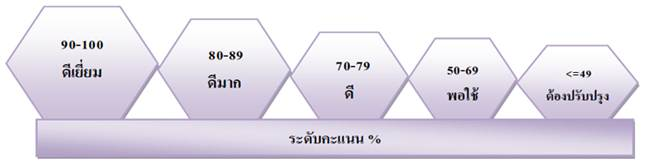
The evaluation process is conducted as follows:
The company has arranged for self-assessment of the Board of Directors by committee and self-assessment of sub-committees by committee, with the Company Secretary's Office responsible for preparing the performance evaluation forms, which are consistent with the guidelines of the Stock Exchange of Thailand and suitable for the company's nature.
The Company Secretary's Office sends the evaluation forms to each director and receives them back to compile the evaluation results and present them to the Nomination and Remuneration Committee.
The Nomination and Remuneration Committee processes and compiles various opinions to be presented to the Board of Directors' meeting, in order to review performance and various issues during the year, as well as to evaluate the effectiveness of the Board's oversight. Furthermore, the evaluation results can be used to support and further improve the operational efficiency of the management.
Summary of the Board of Directors' Self-Assessment by Committee for the Year 2568
Comprising 9 main topics, with an overall average evaluation score in the excellent category, which is 91%. Details are as follows:
Topic | Evaluation Results (%) |
| 91 |
| 92 |
| 92 |
| 91 |
| 85 |
| 96 |
| 91 |
| 94 |
| 92 |
Total | 91 |
Summary of Sub-Committee Self-Assessment by Committee for the Year 2568
Comprising 4 main topics, with an overall average evaluation score in the excellent category, which is 92%. Details are as follows:
Topic | Evaluation Results (%) Year 2568 |
1. Structure and Qualifications of the Sub-Committees | 92 |
2. Sub-Committee Meetings | 94 |
3. Roles, Duties, and Responsibilities of Audit Committee | 96 |
4. Roles, Duties, and Responsibilities of Nomination and Remuneration Committee | 86 |
Total | 92 |
Evaluation of Board Performance in the Past Year
-
Subcommittees
Subcommittees
| Results of the Subcommittee's Duty Performance |
|---|
All of whom possess full qualifications as prescribed by law and are consistent with the business operating strategy. of the company, where the Annual General Meeting of Shareholders resolved to approve according to the recommendations of the Nomination and Remuneration Committee.
2.1 Consider and provide opinions to propose to the Board of Directors to determine the remuneration for the company's directors and sub-committees for the year 2025, by benchmarking against the remuneration rates of directors in the same level of the real estate business group, as well as considering the appropriateness of the scope, duties, and responsibilities of the directors. For the year 2025, the Annual General Meeting of Shareholders approved the company's director remuneration for 2025 as monthly remuneration, as follows:
Chairman of the Board 120,000 Baht Director 50,000 Baht
Chairman of the Executive Committee 20,000 Baht Executive Director 10,000 Baht
Chairman of the Audit Committee 20,000 Baht Audit Committee Member 10,000 Baht
Chairman of the Nomination and Remuneration Committee 20,000 Baht Consider Remuneration Nomination and Remuneration Committee Member 10,000 Baht Excluding the Managing Director, who does not receive such remuneration. Other Benefits for Directors : None 2.2 Consider the performance evaluation and remuneration for the Managing Director for the year 2025, based on performance results, as well as assigned duties, roles, and responsibilities. 2.3 Consider approving employee salary adjustments, position adjustments, and special adjustments.
3.1 Arrange for the performance evaluation of the Nomination and Remuneration Committee for the year 2025, report the evaluation results to the Board of Directors, and disclose them in the company's annual report. 3.2 Review the charter of the Nomination and Remuneration Committee to ensure it is up-to-date and consistent with various criteria that may change. 3.3 Consider improving the organizational structure and new job positions (Position Structure) to lay the foundation for consistent with the company's future growth direction and to support employee growth. Focusing on 3.4 Consider improving employment regulations. to ensure that the regulations concerning employment 3.5 Consider establishing a succession plan for executive positions to ensure continuity of operations. The Nomination and Remuneration Committee has performed its duties and responsibilities as stipulated in its charter with prudence, transparency, adherence to relevant regulations, criteria, and laws, and good corporate governance principles, prioritizing the best interests of the company and its shareholders. |
Meeting Attendance & Remuneration
Meeting Attendance — Sub-section Introduction
During the year 2025 The Board of Directors held a total of 8 times to supervise and oversee the company's management, with regular Board of Directors meetings held. 7 times, and one additional meeting for Non-Executive Directors to provide an opportunity for non-executive directors to discuss various issues related to the company's business operations, as well as provide recommendations to the management.
for further improvement and correction, and the meeting results were reported to the Chief Executive Officer, in line with the company's policy to encourage non-executive directors to hold their own meetings as appropriate, without the presence of executive directors or management.
In 2026, the meeting dates for the Board of Directors and the Annual General Meeting of Shareholders are as follows:
Sequence | The Meeting | Date | Time | Objective | Note |
1. | - Non-Executive Director - Board of Directors | Friday, February 27, 2026 | 1:30 PM 2:00 PM | - To hold a Non-Executive Director Meeting - To approve the annual financial statements for 2025 To set the date for the Annual General Meeting of Shareholders, approve the form 56-1 One Report | Meeting via electronic media / Meeting at the meeting room, 5th floor Ploenchit Tower Building |
2. | Ordinary Meeting Shareholders | Tuesday, April 28, 2026 | 2:00 PM | Consider performance results and appoint auditors, etc. | Meeting via electronic media |
3. | Board of Directors | Tuesday, April 28, 2026 | 4:00 PM | Consider approving the appointment of directors elected by the Shareholders' Meeting to serve on sub-committees. | Meeting via electronic media |
4. | Board of Directors | Friday, May 15, 2026 | 2:00 PM | To approve the Q1/2026 financial statements | Meeting via electronic media / Meeting at the meeting room, 5th floor Ploenchit Tower Building |
5. | Board of Directors | Monday, August 10, 2026 | 2:00 PM | To approve the Q2/2026 financial statements | Meeting via electronic media / Meeting at the meeting room, 5th floor Ploenchit Tower Building |
6. | Board of Directors | Wednesday, November 11, 2026 | 2:00 PM | To approve the Q3/2026 financial statements | Meeting via electronic media / Meeting at the meeting room, 5th floor Ploenchit Tower Building |
7. | Board of Directors | Thursday, December 17, 2026 | 2:00 PM | Additional meeting scheduled | Meeting via electronic media / Meeting at the meeting room, 5th floor Ploenchit Tower Building |
The specified meeting dates, venues/formats may be subject to change, and additional special meetings may be scheduled as required.
Types of Remuneration of the Board of Directors
Monthly Remuneration for Directors The Board of Directors receives monthly remuneration, with details as follows:
Remuneration for Chairman and Directors The Chairman of the Board receives a monthly remuneration of 120,000 Baht, and directors receive a monthly remuneration of 50,000 Baht.
Remuneration for Sub-Committee Members Directors appointed to sub-committees receive additional remuneration based on their responsibilities, as follows:
2.1 Executive Committee The Chairman of the Executive Committee receives a monthly remuneration of 20,000 Baht, and executive committee members receive a monthly remuneration of 10,000 Baht.
2.2 Audit Committee The Chairman of the Audit Committee receives a monthly remuneration of 20,000 Baht, and audit committee members receive a monthly remuneration of 10,000 Baht.
2.3 Nomination and Remuneration Committee The Chairman of the Nomination and Remuneration Committee receives a monthly remuneration of 20,000 Baht, and nomination and remuneration committee members receive a monthly remuneration of 10,000 Baht.
Remuneration or Benefits Payable to the Board
| Metric | Amount (Baht) |
|---|---|
| Remunerations or benefits pending payment to the board of directors over the past year (baht) | 0 |
Supervision of Subsidiaries & Associated Companies
Does the Company Have Subsidiaries or Associated Companies?
Yes
Is There a Mechanism for Overseeing Subsidiaries and Associated Companies?
Yes
Mechanism for Overseeing Management of Subsidiaries
The company has supervised and overseen the management and operational responsibility of its subsidiaries by appointing qualified and experienced individuals representing the company to serve as directors in the subsidiaries. These appointed directors in the subsidiaries are responsible for acting in the best interest of the subsidiaries.
Furthermore, the company stipulates that individuals appointed by the company must ensure that the subsidiaries have complete and correct regulations regarding connected transactions, the acquisition or disposal of assets, or any other significant transactions of such companies. They must also apply the criteria related to information disclosure and the aforementioned transactions in the same manner as the company's criteria. This also includes overseeing the collection of data and accounting records of the subsidiaries, enabling the company to inspect and compile them for the timely preparation of consolidated financial statements.
Oversight Mechanisms
| Mechanism |
|---|
| Sending representatives to act as directors, executives or controlling persons in proportion to shareholdings |
| Disclosure of financial information and operating results |
Audit Committee Duty Performance
Results of the Audit Committee's Duty Performance in the Past Year
Summary of key duties performed in the year 2025 as follows:
1. Review of Financial Statements
The Audit Committee reviewed the consolidated financial statements, separate financial statements, and financial disclosures presented to shareholders, and opined that they are accurate and complete in accordance with financial reporting standards.
2. Review of Risk Management
The Audit Committee reviewed the annual risk management plan and risk management guidelines to align with changes in the environment and circumstances, considering internal and external factors and potential impacts. It regularly monitored the progress of various risk management activities to control significant risks to an acceptable level, and provided recommendations for systematic and appropriate risk management.
3. Oversight of Internal Audit
The Audit Committee has considered the internal auditor's report and the report on the adequacy assessment of the company's internal control system, in accordance with the guidelines of the Securities and Exchange Commission, and is of the opinion that the company's overall internal control system has no material deficiencies.
4. Compliance with securities and exchange laws, SET regulations, or laws related to the company's business
The Audit Committee reviewed compliance with securities and exchange laws, SET regulations, and laws related to the company's business, and regularly monitored the management's improvement guidelines. In the year 2025 No events were found indicating that the company materially violated laws, SET regulations, or laws related to the company's business.
5. Review of connected transactions or transactions that may have conflicts of interest
The Audit Committee reviewed the disclosure of connected transactions to ensure compliance with the principles of preventing conflicts of interest and to ensure full disclosure of information.
6. Review of compliance with anti-corruption measures
As the company has joined the Private Sector Collective Action Coalition Against Corruption (CAC), the Audit Committee reviewed the measures.
internal control, including compliance with anti-corruption measures, and regularly monitored corruption-related complaints every quarter. The company has adequate and appropriate internal control and risk oversight systems.
In 2025, the Audit Committee reviewed policies and measures related to anti-corruption as follows:
Anti-Corruption Policy
Whistleblowing and Complaint Handling Policy
Policy on Giving and Receiving Gifts, Entertainment, and Hospitality Services
Operating Procedures on Anti-Corruption Measures in Human Resources
7. Consideration, selection, proposal for appointment, and determination of auditor's remuneration for the fiscal year 2025
The Audit Committee proposed to the Board of Directors to present to the Shareholders' Meeting for consideration of appointment.
Ms. Kingkarn Atsawarungsarit, Certified Public Accountant No. 4496, or
Ms. Pimjai Manitkajornkij, Certified Public Accountant No. 4521, or 4521 or
<9xU7CLAjt5NE_espace>
Ms. Naraya Srisuk, Certified Public Accountant No. 9188
of EY Office Limited as the company's auditor for the fiscal year 2025 by setting the audit fee for Eastern Star Real Estate Public Company Limited not exceeding 1,490,000 Baht
8. Other duties as per the Charter
In the year In 2025, the Audit Committee performed other duties as stipulated in the Audit Committee Charter to support good corporate governance, enhance the efficiency of the company's internal control and risk management systems, with key details as follows:
Review of the Audit Committee Charter to ensure suitability, modernity, and compliance with good corporate governance principles, relevant laws, regulations, and practices, as well as the current roles and responsibilities of the Audit Committee.
Review of the Internal Audit Charter to ensure clarity in the scope, duties, and independence of the internal audit unit, and compliance with professional internal audit standards, including supporting its role in adding value and improving the company's operational processes.
Consider and approve the appointment of the Head of Internal Audit and the Head of Corporate Governance of the company. based on qualifications, knowledge, abilities, experience, and independence, to ensure that such personnel can perform their duties efficiently and appropriately support the company's good corporate governance.
The Audit Committee is of the opinion that the company's financial information reports are accurate, complete, reliable, and in accordance with generally accepted accounting standards. The company has adequate and appropriate internal control and risk management systems, with continuous development and improvement of operational processes to enhance quality, ensuring that the company's operations align with overall objectives and goals, can adapt to rapidly changing situations, and maintain sufficient good corporate governance.
Executive Committee Duty Performance
Results of the Executive Committee's Duty Performance in the Past Year
-